
Managers: Prof. Dr. Judith Sluimer and Prof. Dr. Erik Biessen (Pathology), Prof. Dr. Barend Mees (Surgery)
Coordinator: Dr. Marjo Donners, contact: marjo.donners@maastrichtuniversity.nl
General focus: carotid artery atherosclerosis and comorbidity impact
Cohort 1: AtheroMaas-1 (formerly known as “MaasHPS”)
Study aim: to define critical processes and their regulators of disease progression in human atherosclerosis
Study design: In a long-standing collaboration between the Dept. Of Pathology and Dept. of Vascular Surgery (since late 1990s) we have been collecting human atherosclerotic plaque material, either from surgery or autopsy. The majority of plaque specimens were obtained from carotid endarterectomy (CEA) procedures, although aorta and femoral plaques as well as healthy vessel wall (mammary or carotid artery) have been obtained as well.
Plaques specimens are routinely cut into parallel, transverse segments of 5‐mm thickness, which are alternatingly snap‐frozen in liquid nitrogen and stored at −80°C, while the flanking sections were formalin-fixed and embedded in paraffin for thorough histological characterization (see figure below). Snap-frozen plaques are classified based on histological composition of both flanking segments and have been used for (multi-)omics analyses (PMID: 34661425; PMID: 34185408).
Table 1: AtheroMaas 1 – Basic setup and findings on multiomics integration and network
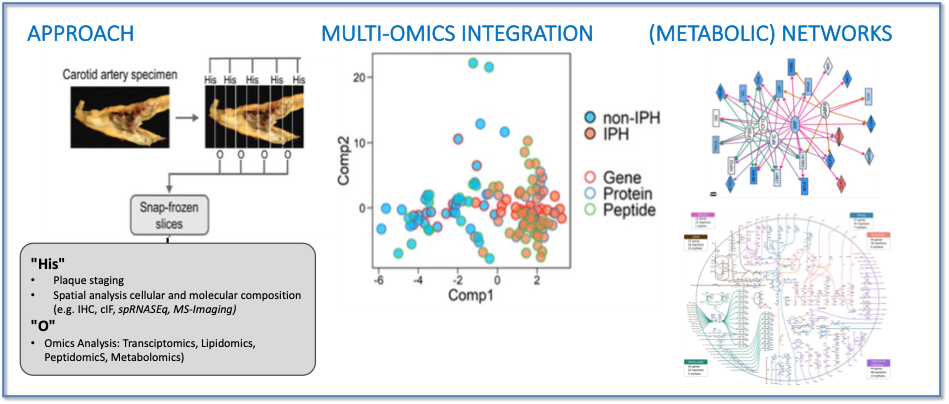
References: Van Kuijk et al., Cardiovasc Res. 2023 Jul 4;119(7):1509-1523; Jin et al., Clin Transl Med. 2021 Jun;11(6):e458; Jin et al., Circ Res. 2021 Dec 3;129(12):1175-1177; Rademakers et al., Angiogenesis. 2024 Aug;27(3):461-474; Jin et al., Cardiovasc Diabetol. 2024 Jul 8;23(1):240. Jin et al., Genome Med. 2025 Oct 2;17(1):109.
COHORT 2: ATHEROMAAS-2
Study aim: to increase analytical power allowing more precise definition of comorbidity impact in human atherosclerosis, retrospective and prospective correlation analysis, and paired analysis with blood (biomarker search).
Study design: While insightful in defining central hubs in plaque destabilization, AtheroMAAS-1’s potential was limited by its moderate power, the lack of inclusion of women, and the lack of options to link plaque findings to clinical data and/or blood characteristics. This has led to a followup study, ATHEROMAAS-2, to tackle these flaws in one shot. As shown in the below table AtheroMAAS-2 is featuring.
Table 2: AtheroMaas in numbers
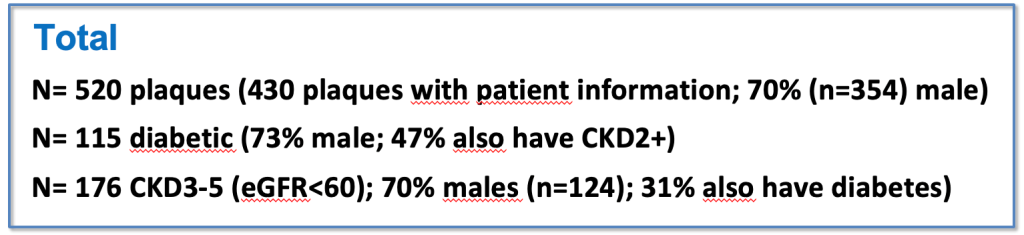
Table 3: General setup of AtheroMaas
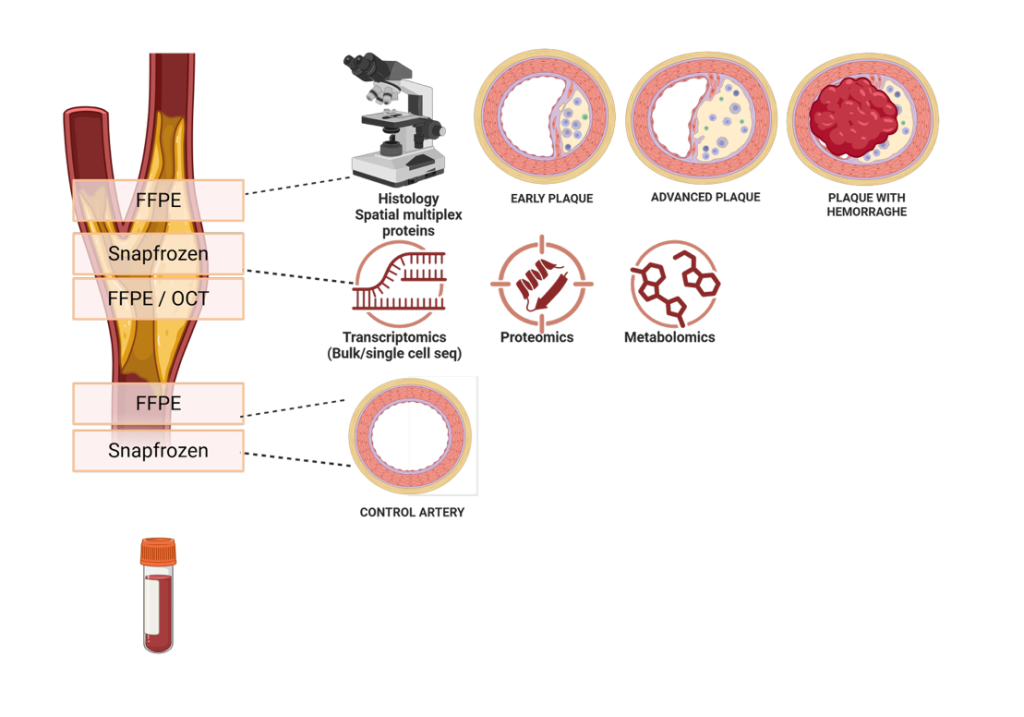
Retrospectively, we also collect clinical information (e.g. age, gender, LDL/HDL cholesterol levels, blood pressure, glucose and creatinine levels, smoking status as well as prescribed medication and radiographic imaging).
Available resources: FFPE, cryo, lysates
Envisioned analyses: scRNASEq, proteomics, metabolomics, spatial RNASEq, spatial multiplex microscopy analysis, paired proteomics and flow cytometry on circulating cells and serum